
Gender Equity/Verification Policies in Women’s Athletics
Elif Gündüz Bayer
Orthodontist- Sports Dentist
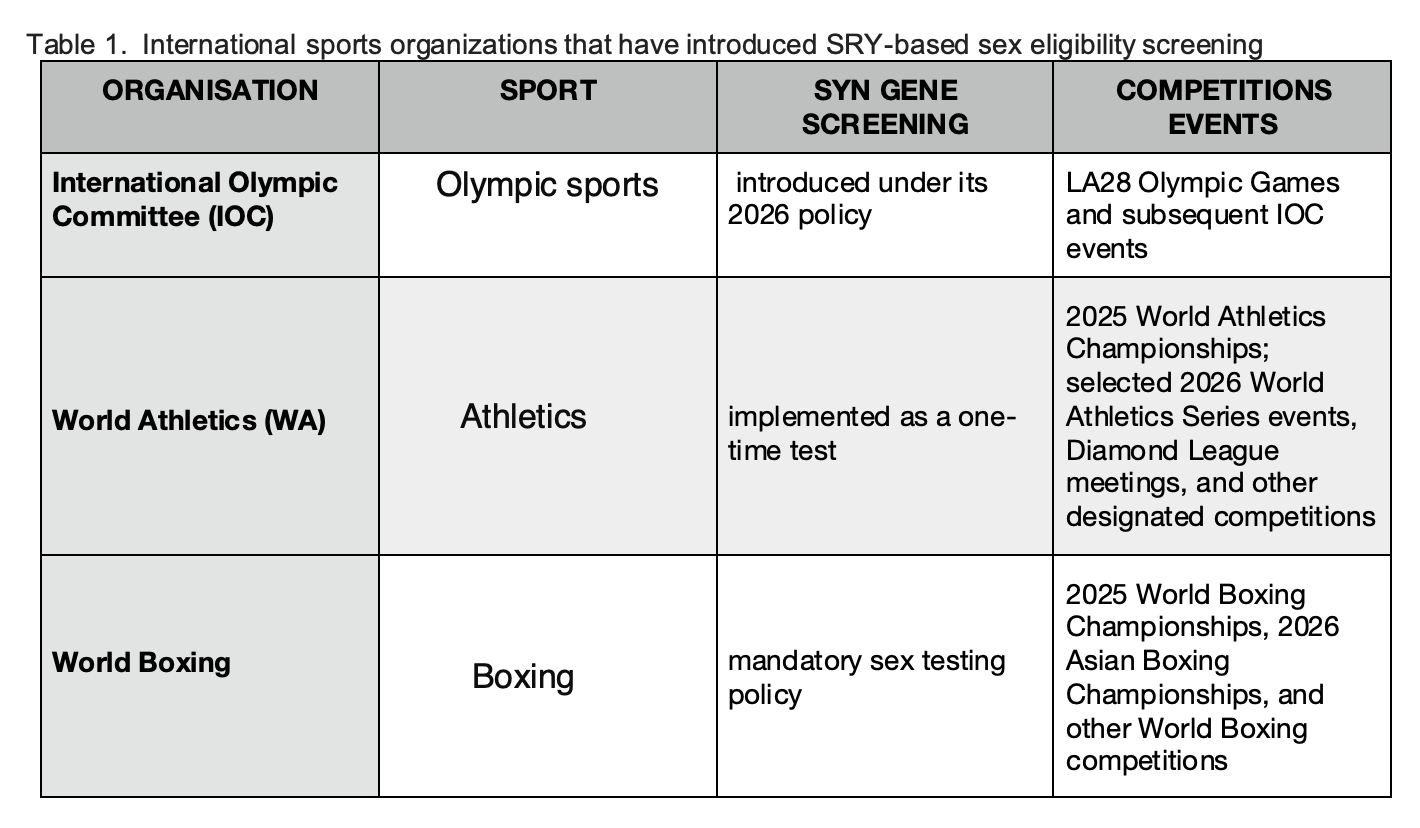
Gender verification in women’s athletics remains one of the most controversial issues in modern elite sport. Ahead of the LA28 Olympic Games, the International Olympic Committee (IOC) has introduced updated eligibility rules that restrict the women’s category based on biological sex, using one-time SRY gene screening (sex-determining region Y gene). Exceptions are for specific differences of sex development (DSD) conditions, including complete androgen insensitivity syndrome (CAIS) and rare cases in which athletes do not develop the typical physiological advantages associated with male puberty. [1].
Only SRY-negative competitors may compete in women’s competitions. The SRY gene, located on the Y chromosome, plays a key role in male sex development. Researchers have linked male-typical physiological characteristics, including greater muscle mass and higher testosterone levels, to performance advantages in some strength, speed, and endurance events [2, 3].
Supporters of sex-based eligibility rules argue that they are necessary to protect fairness and competitive balance in women’s sport. However, human rights organizations have raised concerns about privacy, dignity, bodily autonomy, and discrimination. Human Rights Watch (2020) and the World Medical Association have criticized sex-verification policies and regulations that may affect transgender athletes and women with DSDs [4, 5, 6]. The World Medical Association (2019) has also stressed the importance of informed consent and medical necessity [5].
As LA28 approaches, the debate is likely to remain focused on several interconnected questions:
1-How biological sex should be defined for sporting purposes; 2-How physiological differences should be considered in competition; 3-How athletes with DSDs and transgender athletes should be treated; and 4-How sporting organizations can address competitive fairness alongside privacy, inclusion, and human rights [1, 4, 7]. At the same time, practical and legal challenges surrounding SRY testing remain, including uncertainty over who will administer the tests and cover the associated costs, as well as differences in national laws that may restrict genetic testing for purposes other than medical diagnosis or treatment.
References
1. International Olympic Committee. (2026, March 26). International Olympic Committee announces new policy on the protection of the female (women’s) category in Olympic sport. IOC Newsroom. https://newsroom.olympics.com/record/3615
2. Hunter, S. K., Angadi, S. S., Bhargava, A., Harper, J., Hirschberg, A. L., Levine, B. D., Moreau, K.-L., Nokoff, N. J., Stachenfeld, N. S., & Bermon, S. (2023). The biological basis of sex differences in athletic performance: Consensus statement for the American College of Sports Medicine. Medicine & Science in Sports & Exercise, 55(12), 2328–2360. https://doi.org/10.1249/MSS.0000000000003300
3. Bermon, S., & Garnier, P.-Y. (2017). Serum androgen levels and their relation to performance in track and field: Mass spectrometry results from 2127 observations in male and female elite athletes. British Journal of Sports Medicine, 51(17), 1309–1314. https://doi.org/10.1136/bjsports-2017-097792
4. Human Rights Watch. (2020, December 4). “They’re chasing us away from sport”: Human rights violations in sex testing of elite women athletes. https://www.hrw.org/report/2020/12/04/theyre-chasing-us-away-sport/human-rights-violations-sex-testing-elite-women
5. World Medical Association. (2019, May 2). WMA urges physicians not to implement IAAF rules on classifying women athletes. https://www.wma.net/news-post/wma-urges-physicians-not-to-implement-iaaf-rules-on-classifying-women-athletes/
6. World Medical Association. (2023). WMA policy on World Athletics gender rules for classifying female athletes. In WMA Handbook of Policies. https://www.wma.net/hb-e-version-2023/
7. Pielke, R., Tucker, R., & Boye, E. (2019). Scientific integrity and the IAAF testosterone regulations. The International Sports Law Journal, 19, 18–26. https://doi.org/10.1007/s40318-019-00143-w